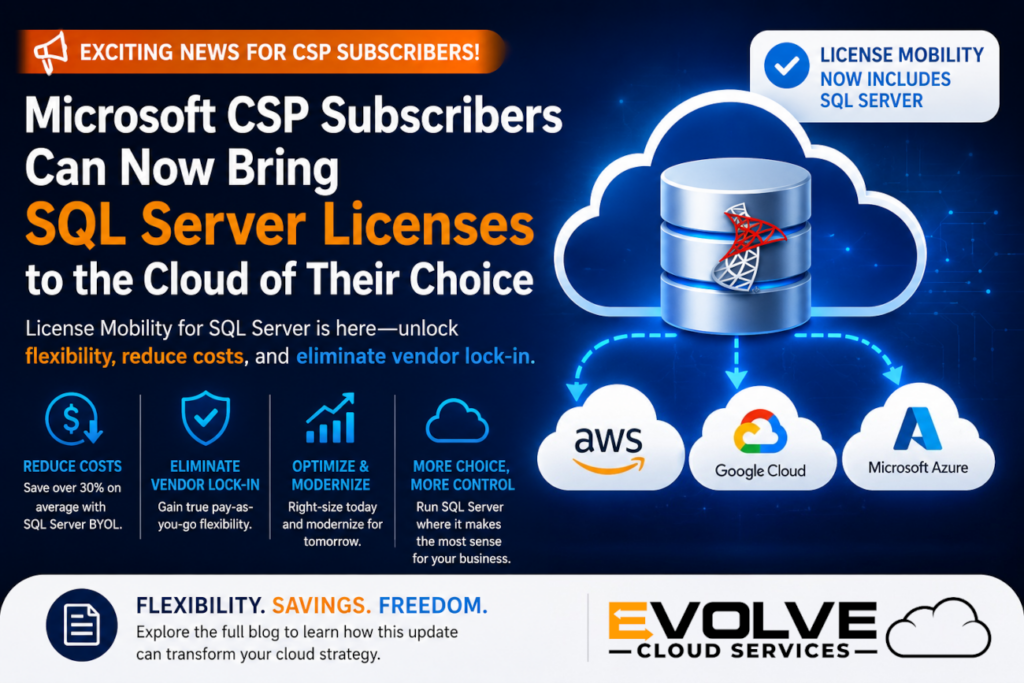
Microsoft announced an update on April 1st, 2026, that extended License Mobility to SQL Server subscription licenses purchased through the Cloud Solution Provider (CSP) program, which makes these licenses eligible for Bring Your Own Licensing (BYOL) in the cloud environments of Authorized Mobility Partners. Prior to this change, SQL Server licenses purchased through CSP did not have License Mobility and were limited to on-premises or Azure deployment.
This is exciting news for CSP subscribers who can now explore the cost advantage of bringing SQL Server licenses to alternative cloud environments including AWS and Google Cloud. SQL Server BYOL can have a significant impact on licensing cost in the cloud. After completing over 4000 optimization and licensing assessments, Evolve Cloud Services has found that SQL Server BYOL results in an average savings of over 30% when compared to the cost of purchasing SQL Server through the cloud provider.
Which SQL Server Licenses Have License Mobility in CSP?
CSP subscription licenses for SQL Server Standard and SQL Server Enterprise now qualify for License Mobility. While perpetual SQL Server licenses can be purchased through CSP, there is no option to add Software Assurance. As a result, perpetual SQL Server licenses purchased through CSP do not have License Mobility.
What is Microsoft CSP?
Under the Cloud Solution Provider (CSP) program, businesses purchase Microsoft licenses and services through Microsoft Cloud Solution Providers instead of transacting directly with Microsoft. The CSP partner also provides billing and technical support to their customer. Depending on whether the customer’s CSP partner is direct or indirect, the CSP partner may either contract directly with Microsoft, or they may transact through another CSP partner who owns the relationship with Microsoft.
CSP offers monthly, annual, or three-year subscriptions. CSP monthly subscriptions offer the most flexibility because customers are billed depending on what they use, which can vary from month to month. In contrast, CSP annual agreements offer a discount in return for an annual commitment. While annual agreements offer monthly billing, they are best suited for predictable workloads because license quantities can only be reduced annually. Finally, CSP three-year agreements offer additional discounting, but there are no options for monthly billing or the reduction of licenses throughout the commitment period.
Businesses with under 2500 users are typically the best fit for CSP. Due to the volume-based discounts available under the Enterprise Agreement (EA), CSP is an unlikely fit for enterprise customers with more than 2500 users.
Moving to CSP Can Eliminate Vendor Lock-In, which Helps You Optimize and Modernize in the Cloud
Purchasing Microsoft licenses through traditional licensing programs results in long term “Vendor Lock-in”, which is challenging for businesses who want to reduce or eliminate their Microsoft licensing spend. When perpetual licenses and Software Assurance are purchased or renewed through EA or Open Value, businesses must commit to three years where there can be no reductions. In contrast, when subscription licenses are purchased through Enterprise Agreement Subscription (EAS) or Open Value Subscription (OVS), quantities can be reduced yearly at the renewal anniversary. However, neither of these arrangements are pay-as you-go because they do not allow for monthly reductions in licensing counts. This essentially locks businesses into Microsoft technology due to licensing commitments. The option for pay-as-you-go for SQL Server under CSP is attractive for businesses who plan to reduce, or even eliminate, SQL Server licensing.
Scenarios where SQL Server license requirements may be reduced or eliminated include:
- Optimization
- Seasonal shifts
- Business Downturns
- Modernization
Businesses working with Evolve Cloud Services often find that their SQL Server licensing can be reduced through “right-sizing” and using the most ideal instance sizes. Businesses with changing seasonal requirements, or potential business downturns, may find pay-as-you-go SQL Server licensing advantageous. While these licensing options may be valuable for businesses that rely on SQL Server, the most exciting opportunity today is modernization, which can eliminate SQL Server and the associated licensing cost.
Modernization refers to the replacement of traditional technologies, such as SQL Server, with born in the cloud technologies. Modernizing a workload to a cloud-based solution offers several advantages including:
- Increased developer productivity and innovation as a shift is made away from managing hardware and updating software
- Pay-as-you-go software without vendor lock-in
- Better scalability and flexibility to meet dynamic user requirements
- Improved Security and compliance
- Integration with AI and machine learning
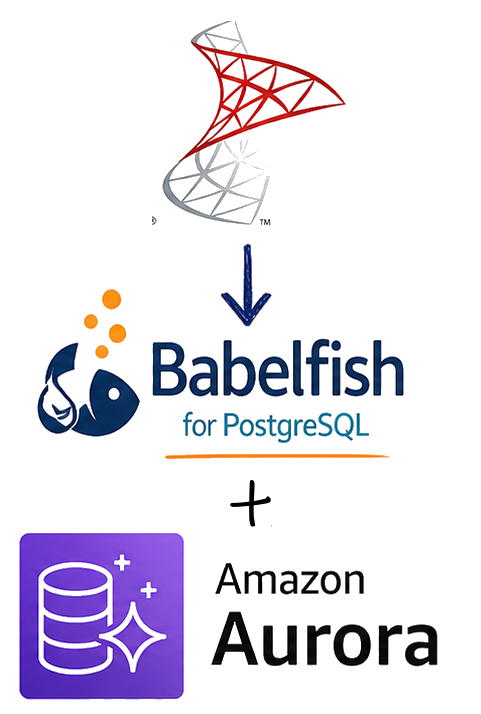
Modernized solutions are available in several public cloud environments, including AWS, Google Cloud, and Azure. These solutions typically utilize open source solutions such as PostgreSQL, MySQL, and DSQL. As mentioned in this Evolve Cloud Services blog, Is today the day to move SQL Server to Open Source?, PostgreSQL is a leading candidate in SQL Server replacement discussions due to its open-source licensing and expanding extension libraries. Amazon Aurora is a good example of a modernized solution that enhances PostgreSQL through separated storage and compute tiers, while including features that improve scalability, performance, and multi-region functionality.
The Evolve Cloud Services Modernization Viability Assessment helps organizations evaluate workload requirements, compare cost, and identify the steps required to modernize each specific workload.
Could CSP help your business reduce cost or licensing commitment in the cloud? Could CSP give you an opportunity to modernize? There are several factors to consider when making these decisions.
Evolve Cloud Services Can Help You Make Informed Technical and Licensing Decisions that Reduce Cost
The Evolve Cloud Services Optimization and Licensing Assessment (OLA) identifies the cost impact of various deployment and licensing options in the cloud. Evolve has learned through experience that every workload is unique and making the best decisions in the cloud requires an in-depth, data-driven analysis of the entire environment.
Evolve begins the process by identifying server count, instance size, software type, usage patterns, and storage/memory requirements through various industry tools. Evolve’s Optimize 24X7 tool then uses this data to right-size the server environment in the cloud while contrasting the cost impact of different licensing options.
For example, a business considering an AWS migration could engage Evolve to evaluate solutions such as Amazon Elastic Cloud (Amazon EC2), Amazon Elastic VMware Service (Amazon EVS) or Nutanix Cloud Clusters (NC2 on AWS). Evolve could also help them evaluate the benefits of a managed database solution such as Amazon Relational Database Services (Amazon RDS) or a modernized solution such as Amazon Aurora.
During an OLA, the Microsoft License Survey (MLS) is typically used to identify the quantity of BYOL-eligible available to a business. Due to the difference between on-prem and cloud licensing models, businesses may require more licenses in the cloud than they own on premises before being optimized. The good news is that Evolve has an 87% success rate in helping businesses optimize and eliminate the need for additional license purchases.
If additional licenses are required, Evolve can identify the appropriate licensing program(s) and the estimated cost. Evolve also contrasts BYOL options with the cost of purchasing licensing through the cloud provider. Additional areas of cost savings during an OLA may include scenarios where SQL Server Standard could replace SQL Server Enterprise, or when non-production environments could use SQL Server Developer for free instead of using a paid license.
At the conclusion of the OLA, businesses have a clear understanding of the cost impact of various licensing models (e.g. license included, BYOL), deployment choices (e.g. shared tenant, dedicated tenant) as well as the benefits and challenges of various licensing programs (e.g. CSP, Enterprise Agreement, Open Value Subscription, etc.).
Do You Want to Learn More About Partnering with Evolve?
If you would like to learn more about receiving a fully funded AWS Optimization and Licensing Assessment, please review the information here.
Information on the Modernization Viability Assessment is available here.
If you have questions about how Evolve Cloud Services can help you, please contact us for more information.